- Home
- Malta Island
- Time in Malta
What Time Is It in Malta Now?
Check Malta’s current local time, time zone and next clock change
The current local time in Malta is displayed below. Malta observes Central European Time during winter and Central European Summer Time in summer. Malta, Gozo, and Comino all follow the same time zone.
Last reviewed: August 2026
Current Local Time in Malta
What is the current local time in Valletta, Malta? The clock underneath is showing the current time in Malta.
Malta Time at a Glance
- One time zone: Malta, Gozo and Comino all follow the same time.
- Winter time: Central European Time (CET) - UTC+1.
- Summer time: Central European Summer Time (CEST) - UTC+2.
- Next clock change: Sunday 25th October 2026, when clocks go back one hour from 03:00 to 02:00
- Malta, Gozo and Comino: All three islands use the same time zone
- Rome and Italy: The same time as Malta
- London and the UK: One hour behind Malta
✍️ Written by Albert and Benjamin Magro, Malta locals sharing practical advice based on living on and exploring the islands.
What You Need To Know About Time In Malta
- Current Time in Malta
- Time Difference Between Malta and Other Countries
- Malta Time Zone
- GMT, UTC, CET and CEST
- Summer and Winter Time in Malta
- Daylight Hours in Malta by Month
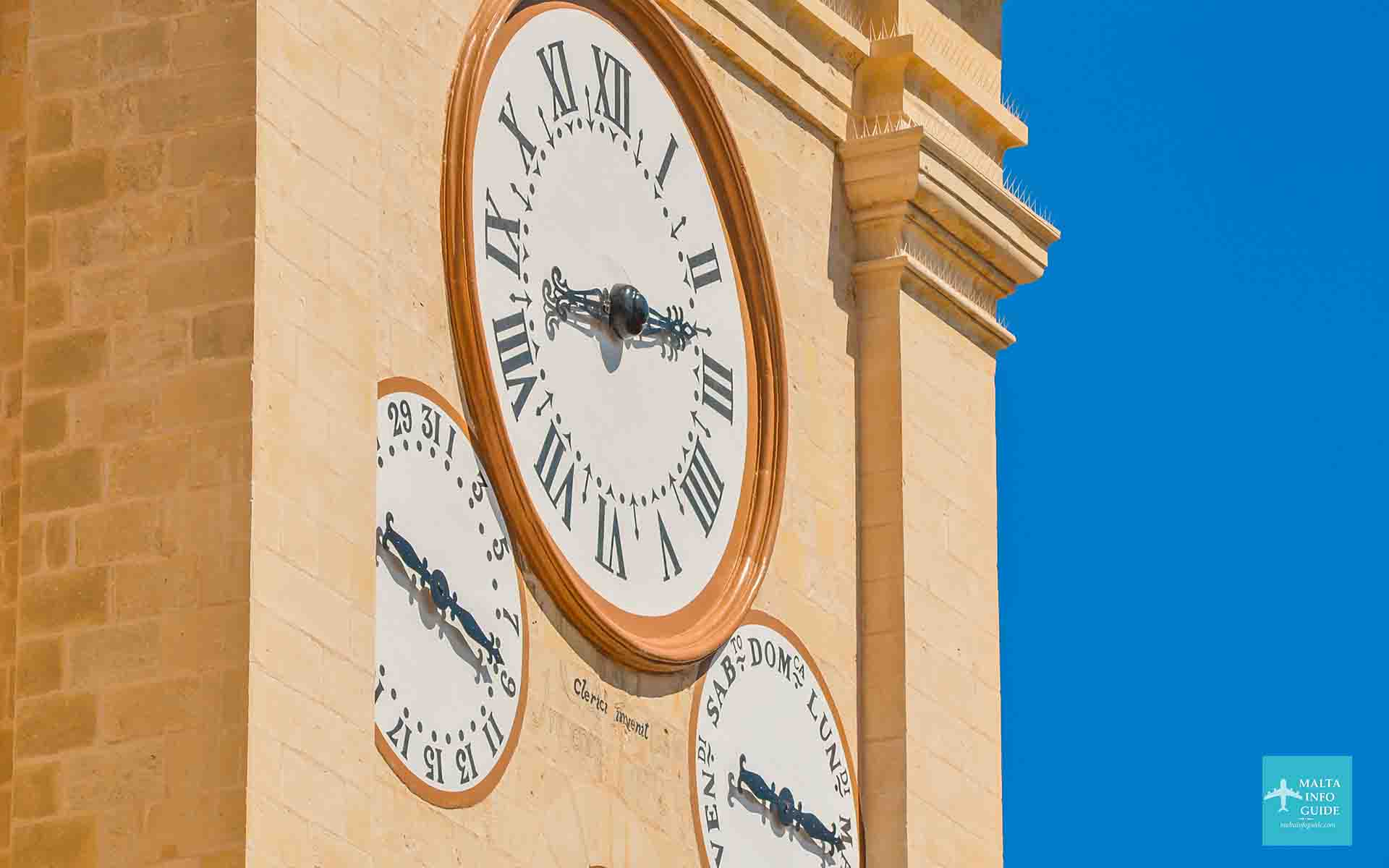 Time in Malta on the St. John's Co-Cathedral
Time Difference Between Malta and Other Countries
Use the live clocks below to compare the current time in Malta with London, Rome and New York.
Malta is one hour ahead of London and uses the same local time as Rome. New York is usually six hours behind Malta, although the difference is briefly five hours when the United States and Europe change their clocks on different dates.
London Time
Loading…Rome Time
Loading…New York Time
Loading…Malta Time Compared With Other Countries
| Time Compared With Malta | Countries And Locations |
|---|---|
| Same time as Malta | Italy, France, Germany, Austria, Belgium, Croatia, Czechia, Denmark, Hungary, Luxembourg, the Netherlands, Norway, Poland, Slovakia, Slovenia, mainland Spain, Sweden and Switzerland |
| Usually one hour behind Malta | United Kingdom, Ireland and Portugal |
| Usually one hour ahead of Malta | Bulgaria, Cyprus, Estonia, Finland, Greece, Latvia, Lithuania and Romania |
| New York | Usually six hours behind Malta, but briefly five hours behind when the United States and Europe change their clocks on different dates |
What Time Zone Is Malta In?
Malta uses Central European Time during winter and Central European Summer Time during summer.
- Winter time: Central European Time (CET) — UTC+1
- Summer time: Central European Summer Time (CEST) — UTC+2
Does Malta have one time zone?
- Yes. Malta, Gozo and Comino all follow the same time zone, so there is no time difference between the Maltese islands.
What Do GMT, UTC, CET and CEST Mean?
UTC is the international standard for timekeeping that is used to calculate time zones across the globe. GMT, or Greenwich Mean Time, originally referred to the average solar time at the Royal Observatory in Greenwich, London. Today, it is commonly associated with the UTC+0 time zone.
For daily timekeeping purposes, GMT and UTC display the same clock time, although UTC is considered the modern international time standard.
- GMT: Greenwich Mean Time — UTC+0
- UTC: Coordinated Universal Time
- CET: Central European Time — UTC+1
- CEST: Central European Summer Time — UTC+2
Malta uses CET during winter and CEST during summer.
Summer and Winter Time in Malta
Malta changes its clocks twice each year. During summer, Malta uses Central European Summer Time (CEST), which is UTC+2. During winter, it uses Central European Time (CET), which is UTC+1.
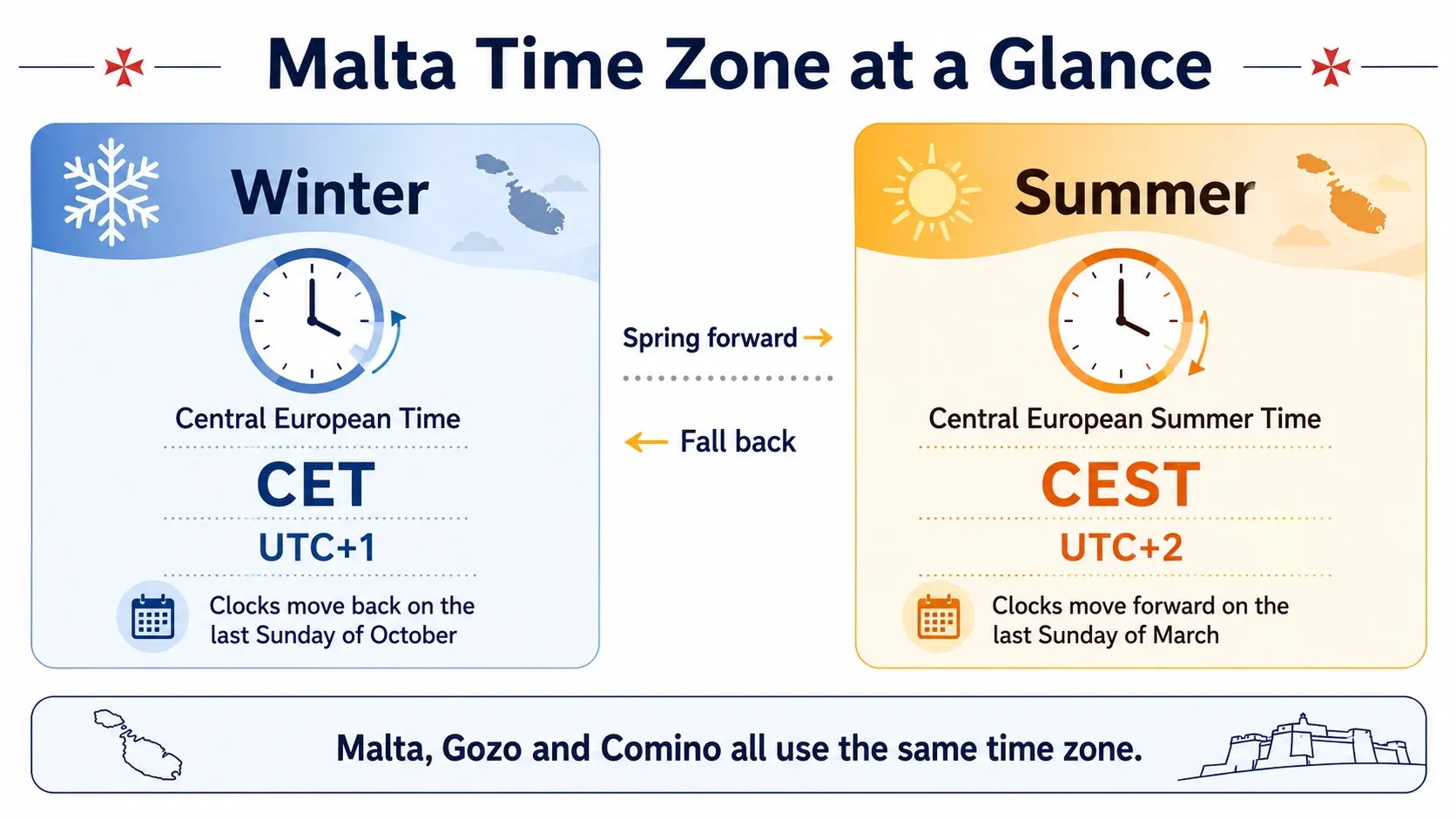 Malta Time Zone at a Glance
Does Malta Use Daylight Saving Time?
Yes. Malta observes Daylight Saving Time, commonly shortened to DST.
Under current EU rules, Malta and other EU countries move their clocks forward and back on the same dates each year.
The clocks move forward by one hour in spring and back by one hour in autumn:
- Spring forward: The clocks move forward by one hour.
- Fall back: The clocks move back by one hour.
Most phones, computers and other connected devices change the time automatically when the automatic date and time setting is enabled.
When Do the Clocks Change in Malta?
Summer time begins on the last Sunday of March. At 02:00, the clocks move forward to 03:00.
Winter time begins on the last Sunday of October. At 03:00, the clocks move back to 02:00.
Malta Clock Change Dates
2026
- Summer time began on Sunday, 29 March 2026.
- Winter time begins on Sunday, 25 October 2026.
2027
- Summer time begins on Sunday, 28 March 2027.
- Winter time begins on Sunday, 31 October 2027.
Daylight Hours in Malta by Month
Malta has around 9 hours and 45 minutes of daylight during the shortest winter days and approximately 14 hours and 30 minutes during the longest summer days.
The table below shows the approximate range of daylight hours during each month. Exact sunrise and sunset times vary slightly according to the date and year.
| Month | Approximate Daylight Range |
|---|---|
| January | 9 hours 45 minutes to 10 hours 25 minutes |
| February | 10 hours 25 minutes to 11 hours 20 minutes |
| March | 11 hours 20 minutes to 12 hours 35 minutes |
| April | 12 hours 35 minutes to 13 hours 40 minutes |
| May | 13 hours 40 minutes to 14 hours 25 minutes |
| June | 14 hours 25 minutes to 14 hours 35 minutes |
| July | 14 hours to 14 hours 35 minutes |
| August | 13 hours to 14 hours |
| September | 11 hours 50 minutes to 13 hours |
| October | 10 hours 45 minutes to 11 hours 50 minutes |
| November | 9 hours 55 minutes to 10 hours 40 minutes |
| December | Around 9 hours 45 minutes to 9 hours 55 minutes |
The longest days occur around 21st June, while the shortest days occur around 21st December.
The table below shows the approximate range of daylight hours during each month. Exact day length varies slightly by date and year.
Disclaimer — We may earn a commission if you book via certain links on the website. No extra cost to you.
🎉 What’s On In Malta?
Updated for September • Local picks
Discover events, village feasts, fireworks, festivals and seasonal things to do this September.
📅 See What’s Happening This September ⛪ Malta Village Feasts 🌞 Things To Do In Malta 🗓️ Events By Month❤️ Enjoying Malta Info Guide?
If our free local guides made planning your Malta trip easier, you can say thanks with a small beer.
Written by two locals. Always free.

✈️ Planning your Malta trip?
✈️ Flights to Malta
Compare airlines and find the best prices today.
Check today’s cheapest flights →🏨 Hotels in Malta
Find available rooms, trusted stays and good locations for your Malta trip.
See available hotels this week →🚗 Car Rental in Malta
Compare prices, pick-up points and car options before you book.
Compare car rental prices →Planning London too?
Discover where to stay, what to do, and when to visit London.
Explore London Guide →Recent Articles


-
Christmas Pantos in Malta 2026/27 - Dates, Venues & Tickets
Sep 14, 26 12:07 PM
Find Christmas pantos in Malta and Gozo for 2026/27, with confirmed dates, venues, language, age guidance, booking status and official ticket links. -
Dog Friendly Beaches Malta & Gozo: 16 Official Locations
Sep 13, 26 04:09 AM
Find the 16 official dog friendly beaches in Malta and Gozo, plus the rules on where dogs can swim and what owners need to know before visiting. -
Xlendi Bay Gozo: Local Guide to Swimming, Beach & Tips
Sep 11, 26 03:26 PM
Local guide to Xlendi Bay in Gozo, with advice on swimming, the small beach, restaurants, parking, buses, summer crowds and who Xlendi suits best.